
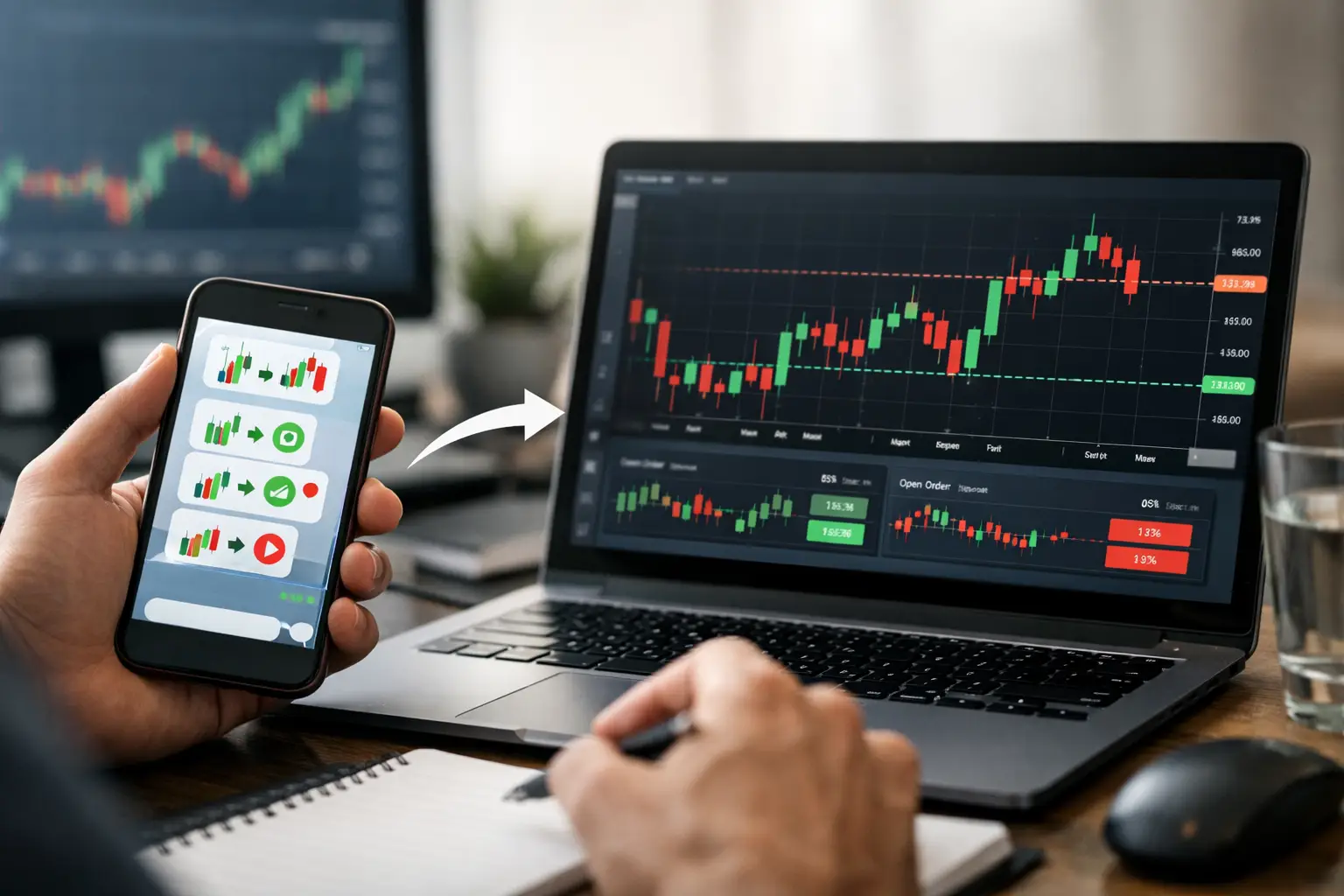
A signal arrives at 9:31:04. Entry is valid for seconds, not minutes. If you are still copying price, stop loss, and take profit from Telegram into MT4 or MT5 by hand, you already know the problem: delay compounds, formatting varies, and one missed digit turns a valid setup into an execution error. That is exactly why more traders now want to copy telegram signals with sl tp rules through an automated routing layer instead of relying on manual trade entry.
Why copying Telegram signals with SL TP rules is harder than it looks
On paper, the workflow sounds simple. A provider posts a signal in Telegram, and the trade gets placed in MetaTrader with the correct stop loss and take profit. In live conditions, that process breaks down fast.
Telegram channels are rarely standardized. One provider writes "BUY XAUUSD @ 2350 SL 2342 TP 2365." Another uses line breaks, emojis, or partial abbreviations. Some post multiple take profit targets. Others send a market alert first, then add stop loss later, then modify targets in a follow-up message. If your copier cannot parse those variations consistently, SL and TP handling becomes unreliable.
That matters because stop loss and take profit are not cosmetic fields. They define the risk boundary and the expected exit logic of the trade. If those values are skipped, misread, or applied to the wrong symbol format, the account is no longer following the signal provider's system. It is following execution drift.
What a proper SL/TP signal copier needs to do
If the goal is to copy telegram signals with sl tp rules reliably, the system has to do more than detect a ticker and click Buy or Sell. It needs a structured pipeline.
Parse inconsistent message formats
The first requirement is message normalization. Telegram signals are unstructured text. A production-grade copier needs to ingest those messages, identify the symbol, side, entry conditions, stop loss, and one or more take profit values, then convert them into standardized trade instructions.
This is where simple keyword scripts usually fail. They work until the signal format changes. A cloud-based parser with AI-assisted normalization is far more resilient because it can interpret message variations instead of depending on a single rigid template.
Apply SL and TP rules before execution
A second requirement is rule enforcement. Some users want to copy the provider's exact stop loss and take profit. Others want account-level overrides, such as fixed risk per trade, no TP on scalp accounts, or adjusted TP distances for specific brokers or funded accounts.
The right system handles both. It should let the signal structure pass through accurately while still enforcing centrally defined controls per account. That distinction matters for signal providers managing many clients and for trading teams that need consistent governance across different MT4 and MT5 endpoints.
Route trades without duplicates
When one Telegram channel serves multiple accounts, duplicate handling becomes operationally important. If routing logic is weak, a reconnection event or message refresh can trigger repeated orders. The result is not just a nuisance. It can create exposure that exceeds the intended SL/TP framework.
A serious copier should maintain message state, account routing logic, and execution acknowledgments so each trade is processed once per intended destination.
The operational case for automation
Most traders first think about convenience. The stronger case is control.
Manual copying introduces inconsistent timing, inconsistent lot sizing, and inconsistent SL/TP placement. Even if you are careful, human execution is not deterministic. In a team setting, it becomes worse because different operators interpret the same Telegram message differently.
Automation solves that by turning a chat message into a repeatable execution event. The signal is ingested once, parsed once, validated once, and routed according to predefined rules. That is the difference between a hobby workflow and trade operations infrastructure.
For individual traders, that means fewer missed entries and fewer mistakes when markets move quickly. For signal providers, it means clients receive a more consistent experience. For prop firms and funded-account programs, it creates a compliance layer where risk controls are defined centrally instead of depending on whatever settings happen to exist inside each terminal.
How to copy Telegram signals with SL TP rules into MT4/MT5
The cleanest setup uses a cloud service to ingest Telegram messages and a local EA on MT4 or MT5 to execute structured commands. That architecture keeps Telegram session handling, parsing, and routing in the cloud while the terminal polls for instructions through a low-latency API.
Step 1: Connect the Telegram source
Start by defining which Telegram channels or groups will feed signals into the system. For a solo trader, that may be one private channel. For a provider or desk, it may be several channels segmented by strategy, asset class, or client tier.
At this stage, access control matters. You want clear mapping between the source and the destination accounts, especially if different groups should trigger different risk settings.
Step 2: Map symbols and message behavior
Not every broker uses the same symbol naming. Gold might be XAUUSD on one server and XAUUSD.a on another. Indices and crypto pairs often vary even more. Before SL and TP can be trusted, the symbol mapping has to be correct.
You also need to decide how the copier should handle edge cases. Should it accept market orders only, or pending orders too? Should it require both SL and TP before execution? Should follow-up Telegram messages modify existing positions or open new ones? These are operational decisions, not cosmetic preferences.
Step 3: Define account-level SL/TP and risk rules
This is where a managed system outperforms ad hoc scripts. You can preserve the provider's stop loss and take profit logic while still applying account-specific controls such as lot sizing, max risk, trade filters, or expiration policies.
For example, one account may follow the signal exactly, another may reduce position size by 50%, and a third may block trades without a valid stop loss. All three can consume the same Telegram source while executing under different governance rules.
Step 4: Deploy the MT4/MT5 execution endpoint
Once the parsing and routing rules are ready, the MetaTrader side needs an EA configured to receive commands. The best implementations use a pull model through WebRequest polling because it is stable, simple to audit, and broker-platform friendly.
Execution speed matters here, but reliability matters more. A few milliseconds saved do not help if the terminal loses sync or if a fragile VPS script crashes during market hours. A cloud-based stack with a high-availability ingestion layer and a consistent polling mechanism gives you a more dependable path from Telegram message to order placement.
Step 5: Test modifications, not just entries
Many users test only the first order. That is not enough. If you want to copy telegram signals with sl tp rules properly, you need to test the full signal lifecycle: initial entry, stop loss amendments, take profit updates, partial closes, and close-all instructions.
This is where operational quality shows up. A copier that handles clean entries but fails on modifications will still create trading drift over time.
Where most setups fail
The weak point is usually not the trade entry. It is everything around it.
Some systems break when a provider changes message format. Others cannot distinguish between a fresh signal and a reply message. Some handle one account well but become unstable when routing across multiple MT instances. And many give users no centralized visibility into licensing, expiries, or account-level permissions.
That is a serious limitation if you are distributing signals commercially or operating funded accounts at scale. You need to know which client is active, which account is authorized, and which rules are being enforced before each order reaches the terminal.
This is where a platform like TelegramToMT5Copier fits naturally. It is designed as cloud execution infrastructure, not a one-off Telegram script, with AI-based parsing, multi-account routing, centralized license control, and server-side risk governance built into the workflow.
Who benefits most from this setup
Retail traders benefit when they want faster, more consistent execution without staring at Telegram all day. Signal providers benefit when they need to deliver a standardized client experience and reduce support issues tied to bad manual copying. Trading organizations benefit most when they need scale, because scale exposes every weak link in parsing, routing, and risk enforcement.
There is a trade-off, of course. A more controlled system takes a bit more setup than a basic copier. You need to define mappings, rules, and account behavior clearly. But that upfront structure is exactly what prevents downstream execution errors.
If Telegram is part of your signal workflow, treat it like a market data source, not a chat app. The more precisely you handle SL and TP rules at the ingestion and routing layer, the closer your execution stays to the strategy you intended to follow.